Rendering is the coat of sand, cement, lime or resin that protects and finishes an outside wall. Most work on it falls into five jobs: repairing a damaged area, recolouring sound render, re-rendering a wall or a whole house, stripping an old finish such as pebbledash, or adding insulation under a new render.
01
What the work actually involves
Almost every rendering job starts the same way: someone tapping the wall. Render that is still bonded to the brick or block gives a sharp knock; render that has come away sounds dull and hollow. The inspection also looks at cracks, at how the render meets window sills and copings, and at the bottom of the wall, where the render should stop on a bead above the damp-proof course rather than running down to the ground.
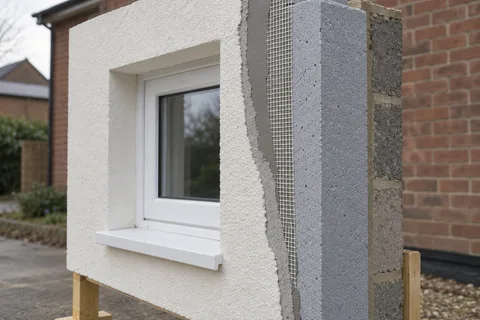
If render has to be replaced, it is hacked off back to the masonry, loose bricks and open joints are repaired, and deep hollows are filled before any new coat goes on. Beads are fixed at the base, corners and window reveals to give straight edges and the right thickness. A traditional sand-and-cement render then goes on in two coats, a scratched undercoat and a finish, with drying time between them. A through-coloured monocouche goes on in one thick coat and is scraped to texture; a silicone finish is a thin coloured layer over a basecoat. Each new coat is sheltered from rain, frost and strong sun while it cures.
02
Choosing the right job for the wall
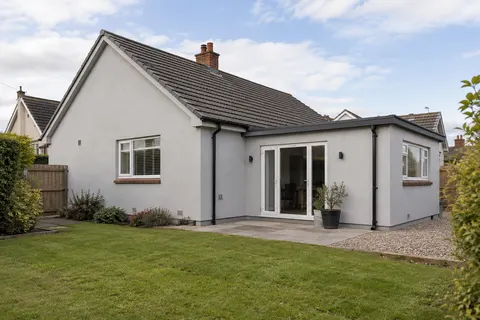
The condition of the render, more than its age, decides the job. If it rings solid when tapped and the problem is fading, staining or a patchwork of colours, the render can stay: cleaning and a colour change is the proportionate answer. If the damage is confined to a few areas, such as a crack from a window corner or a blown patch near a downpipe, a render repair cuts out the failed part and rebuilds it.
Once hollow areas turn up across most of a wall, or across several walls, patching stops making sense and re-rendering that elevation or the whole house gives a consistent result. Pebbledash that is hollow, cracked or shedding stones is usually stripped, which opens the choice of a new finish. And if a solid wall is being stripped anyway, it is worth asking about external wall insulation before the new render is chosen, because re-rendering a large part of a wall can bring building regulations and an insulation upgrade into play.
03
Local walls and local rules
Middlesbrough Council maps eight conservation areas, including Acklam Hall and Marton and The Grove, and its guidance explains that acceptable changes can differ from one area to another. In Linthorpe, an Article 4 direction covers specified properties and includes controls over exterior painting, so a colour change there may need consent. The Historic Quarter takes in parts of the town centre, Middlehaven and the area around the railway station, where a commercial façade has its own heritage context.
Teesside postcodes also cross council boundaries. Saltburn and Guisborough are in Redcar and Cleveland, whose Article 4 direction for Saltburn Conservation Area removes permitted development for exterior painting on every building in the area, and its Guisborough appraisal describes lime render as an authentic finish on the town's sandstone buildings while listing cement render that hides stone as a negative.
04
What makes render last
Most failures begin at an edge or with water from somewhere else. A gutter that overflows, a sill without a drip, or render carried down over the DPC will undo a good render job, so those are put right as part of the work. Choosing a render that suits the wall matters as much: soft old brick or stone generally needs a weaker, more open render than modern blockwork, and some older walls are better served by lime than cement.
Timing matters too. Every render product has minimum temperatures and rules about frost, rain and direct sun, and lime needs the longest protection, so a winter job can stretch out between coats.
Common questions
How do I know whether my render can be saved?
Tap it. If most of it rings solid and the cracks are fine, repair or recolouring is usually possible. Widespread dull, hollow areas mean the render has lost its grip and needs replacing.
Are the same appearance rules used across Teesside?
No. Middlesbrough Council and Redcar and Cleveland Borough Council have different conservation areas and Article 4 directions, so check the rules for the exact address.