Lime render and compatible repairs
Lime rendering in Middlesbrough
Lime render uses lime rather than cement as the binder. It is softer, more flexible and more open to moisture than a cement render, which makes it the usual choice on older solid walls of soft brick or stone laid in lime mortar. It is slower to apply and needs more care in the weeks after it goes on.

On this page
Why lime rather than cement on an old wall
An older solid wall has no cavity. Rain that soaks into it has to dry out again through the faces of the wall. SPAB, the Society for the Protection of Ancient Buildings, explains that a dense Portland cement render restricts that evaporation. Because cement is more rigid than the wall, hairline cracks form, water gets in through them and then cannot easily escape. Cement renders on old walls also tend to fail in patches and come away in sheets, while lime tends to wear back more evenly.
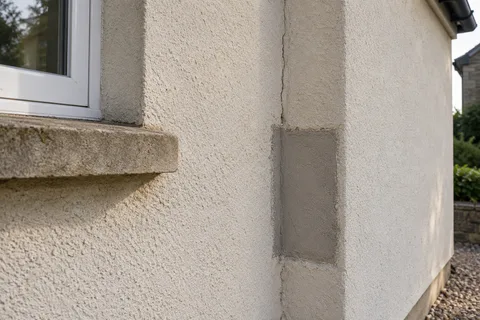
The signs on a house are familiar: a hard grey render with fine cracks, hollow patches that sound dull when tapped, damp staining on inside faces of the same wall, and pieces falling off near the ground. Inside Middlesbrough, the council maps eight conservation areas, including Acklam Hall and Marton and The Grove, and its guidance says acceptable changes differ between them, so an older wall in one of them needs checking address by address. Guisborough is outside Middlesbrough Council's area, but the neighbouring authority's guidance is a useful pointer: Redcar and Cleveland Borough Council's 2024 Guisborough appraisal describes lime render and shelter coats as an authentic historic finish on that town's sandstone buildings and lists cement render obscuring them as a negative.
Lime is not automatic for every old house. Where a cement render is well bonded and the wall behind it is dry, SPAB suggests it may be best left to age, with local repairs to hollow or decayed patches, because stripping it can do more harm than good.
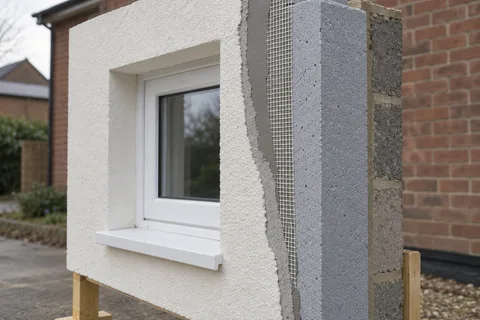
- Stone or brick masonry Cleaned of loose material and dampened so it does not draw water out too fast.
- First (scratch) coat Often haired; scratched to give the next coat a key.
- Second (floating) coat Applied once the first has firmed up; follows the line of the wall.
- Finish coat Thin final coat, kept damp and shaded while it cures.
- Limewash or mineral paint Optional decoration that keeps the wall permeable.
Wall on the left, finish on the right. Not to scale: coats, thicknesses and primers follow the chosen manufacturer’s system and the condition of the wall.
Taking cement render off without damaging the wall
Removal is where most of the risk lies. SPAB advises taking cement render off by hand with hammer and chisel and testing a small area first. Levering off large sheets can tear the faces from soft bricks or stone; power tools belong only in very experienced hands. Any decayed backing must be made sound before re-rendering, and a saturated wall should be allowed to dry before new render goes on.
Expect surprises behind the old coat: soft or eroded bricks, cement pointing, old openings filled with mixed materials, and timber lintels. Each of these needs a repair before the first lime coat goes on.
How the coats go on
Saint-Astier's data sheet for its NHL 3.5 natural hydraulic lime gives a typical hand-applied build-up and the waiting times between coats.
Dampen the wall the day before and again before work, letting surface water soak in.
Apply a stipple coat of 3–5mm on old masonry to give a key.
Wait about two days, then apply a base coat of 10–20mm and scratch it.
Leave the base coat about seven days to firm up and shrink.
Apply the top coat: 5–7mm if floated smooth, 7–12mm if scratched.
Cover the work against sun, wind and rain, misting it lightly if it dries too fast.
Keep frost off it for at least ten days after application.
Weather, curing and timing
The same data sheet says not to work below 8°C or above 30°C. Lime gains strength slowly, so the critical period is the fortnight after each coat rather than the day of application. In practice that pushes lime work on an exposed Teesside elevation towards the warmer months, with hessian or shade netting on the scaffold to stop rapid drying.
Do not be alarmed if a new lime render looks darker in patches after rain. Saint-Astier notes that traditional renders show shading after a shower, which reflects lime's ability to take up and release moisture.
Finishing and looking after it
The finish has to stay as open as the render. SPAB recommends a traditional limewash on most lime renders and warns that ordinary modern masonry paints are less permeable and can trap moisture; it also advises against clear water-repellent treatments because their long-term effects are unknown. Limewash is a thin coat that is reapplied as it wears, which is part of the maintenance of a lime-rendered wall.
After a wall has carried cement render for decades, salts can come out through the new lime, often near the base. SPAB notes that some remedial re-rendering after a couple of years might be required, so allow for that rather than seeing it as failure. For buildings in Middlesbrough's conservation areas, including the Historic Quarter, check with the council before changing the texture or colour of a historic wall.
Common questions
Can lime render go over the existing cement render?
No. Lime over cement keeps the cement's effect on the wall and the lime has a hard, sealed surface to bond to. The cement is removed first, carefully, if lime is the chosen route.
Is lime render weaker?
It is softer by design, so it moves with an old wall and can be repaired locally. On a sound, well-drained wall it is a durable finish when protected properly while it cures.
See housing and planning information for Middlesbrough and nearby places, including the source and geography behind each figure.