Commercial façades and new builds
Commercial and new-build rendering in Middlesbrough
Commercial rendering covers shop fronts, offices, industrial units, schools, blocks of flats and new-build housing. The materials are the same family as on a house, but the walls are larger, the backgrounds more varied, the building is often in use while the work happens, and on some buildings fire regulations restrict which systems can be used.

On this page
New build and refurbishment start from different walls
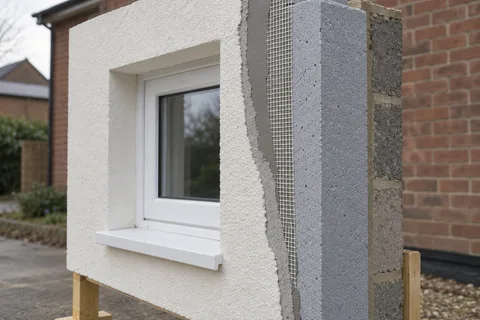
On a new building the renderer receives a wall from the builder: blockwork, concrete, or a framed structure with render carrier boards. Each needs its own system. K Rend, for example, describes its K Mono monocouche as a one-pass finish for most moderate to low strength blockwork, while dense concrete needs a key coat or polymer base coat before anything else. Framed buildings use board-based systems designed and tested as a whole.
On a refurbishment the starting point is an existing façade, often with several generations of render, paint, signage fixings and filled holes. Tap-testing and trial removal at a few points show whether the old render can stay under a new finish or has to come off. Expect the hidden wall behind a long shop frontage to change from bay to bay.
- Background and drawings Blockwork, board or existing façade checked against the specification.
- Set-out Beads, movement joints and bay breaks marked from the drawings.
- Basecoat and mesh Mesh across board joints, openings and changes of background.
- Finish in bays Each bay is finished in one go so day-joints do not show.
- Inspection and handover Hold points and the installed products are recorded.
The usual order of work. The survey and the chosen products decide the actual steps.
Fire rules on taller and residential buildings
Approved Document B controls the materials allowed in external walls. The government's 2022 update extended the ban on combustible materials in and on external walls to hotels, hostels and boarding houses and introduced new rules for the external walls of new blocks of flats between 11 and 18 metres high. The word render covers very different materials. A sand-and-cement coat is mineral, but thin coats such as K Rend Silicone TC are organic resin renders bound with silicone and acrylic resins. On these buildings it is the fire classification of every material in the wall and of the complete system as built, from insulation boards and carrier boards to beads, basecoat and finish, that has to meet the rules, not the name of the top coat.
For other commercial buildings, Approved Document B still sets limits on the combustibility of external wall materials. Which limits apply is a question for the designer or building control, and it should be settled before materials are ordered.
What happens on a commercial façade
This is a typical refurbishment sequence where the building stays open.
Survey and tap-test the façade; open small trial areas to confirm what is under the old finish.
Agree working hours, protected entrances and a pedestrian route clear of the scaffold, with debris netting or fans where the public pass.
Remove signage, lights, alarm boxes and cables, recording each fixing point.
Hack off failed render, repair the background and form beads, movement joints and day-work joints.
Build up the specified coats elevation by elevation, finishing each one in a single run.
Protect fresh render from rain, frost and direct sun while it cures.
Refix signage and services on suitable fixings and seal every penetration through the render.
Keeping the colour even on a big wall
Large plain walls show every change in timing. With a through-coloured monocouche, K Rend warns that early scraping gives a darker shade and late scraping a lighter one, so each elevation must be scraped at the same stage. The same thinking applies to thin coats, which need a continuous wet edge. Breaks should fall at beads, joints or changes of plane rather than mid-panel, and the gang size has to match the area to be finished in one go.
Ask for a sample panel on site. K Rend recommends one so the colour and texture are approved on the actual background, in daylight, before the main application. Keep the approved panel visible until the work is complete.
Movement joints are part of the building design, not a renderer's choice. On long elevations and where different structures meet, the joints in the structure should carry through the render on purpose-made beads.
Town-centre buildings and aftercare
Middlesbrough's Historic Quarter covers parts of the town centre, Middlehaven and the area around the railway station, and its buildings have their own heritage context. Before re-rendering or recolouring a commercial façade there or in another conservation area, check with Middlesbrough Council what consent is needed.
Commercial walls collect dirt near roads and car parks. The Mineral Products Association data sheet notes that where atmospheric pollution is high, a stronger render mix slows the build-up of dirt, and that rendered walls can be cleaned by washing down with water at mains pressure once cracks and damage are repaired. Give the building manager the system details and a note of where signage fixings pass through, so later tenants do not drill into it blind.
Common questions
Is new-build render different from refurbishment render?
The finishes can be the same, but the preparation differs. New blockwork needs to be clean, complete and dry; an old façade needs failed render removed and the background repaired before any new coat goes on.
Can the work be done while a shop or office stays open?
Usually, with protected entrances, a covered walkway or fans over public routes, and noisy hacking off timed around opening hours. Agree that plan before the scaffold goes up.
See housing and planning information for Middlesbrough and nearby places, including the source and geography behind each figure.