Monocouche render
Monocouche rendering in Middlesbrough
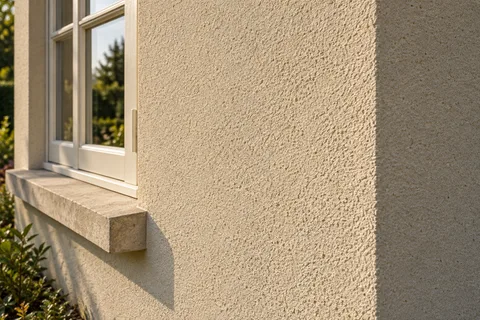
Monocouche is French for "single layer". It is a factory-mixed, through-coloured cement render that is sprayed on thick, levelled, left to firm up and then scraped to an open, slightly granular texture. The colour is in the material, so there is no paint to peel, but the timing of the scrape controls the shade.

On this page
How thick it goes on
K Rend's data sheet for K Mono is a useful worked example. It is a polymer-modified, cement-based render designed for spray machines and described as a one coat, one pass finish over most moderate to low strength blockwork. The operative sprays it to 17–18mm, levels it with a straight edge or spatula, lets it set for anywhere between 3 and 24 hours depending on the wall and the drying conditions, and then scrapes the surface. The minimum finished thickness after scraping is 15mm.
That thickness is the point. A monocouche is the weatherproof layer as well as the decoration, so a thin spot is a weak spot. The data sheet stresses a consistent minimum thickness over the whole surface and says the maximum should not be exceeded. Ashlar lines cut into it still need 15mm of render left behind the groove.
- Background Usually blockwork or brick; uneven or mixed walls may need a levelling coat.
- Beads and mesh Beads at corners, reveals and the base; mesh over junctions and lintels.
- Monocouche passes One through-coloured material, applied in passes to the specified thickness.
- Scraped surface Scraped once partly set, which removes the skin and leaves the texture.
Wall on the left, finish on the right. Not to scale: coats, thicknesses and primers follow the chosen manufacturer’s system and the condition of the wall.
Where it suits, and where it does not
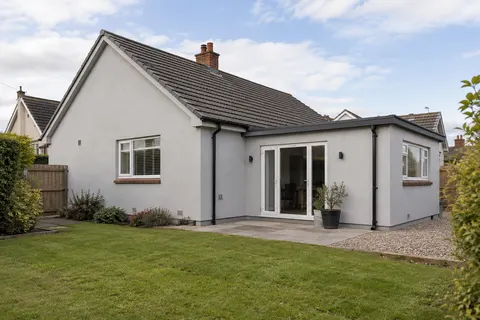
Monocouche fits new work best: a blockwork extension, a new-build gable or a wall that has been hacked back to sound block or brick. It saves the separate paint coat and copes with large plain elevations, which is why it is common on new housing.
It is a poor match for painted walls, hollow old render or very dense, smooth backgrounds without a key coat. It is also cement-based, so it is not the answer for an older solid wall that relies on lime and needs to dry out through its face. And it is awkward for small repairs: a patch rarely matches a wall that has weathered for years.
What happens on the day
Spraying and scraping are two separate visits to each elevation, usually on consecutive days. Doors, windows and anything else nearby are covered in polythene first because the spray travels.
Check the blockwork is clean, sound and free of anything that stops adhesion; repair or fill first.
Fix bell-cast, stop and corner beads to the finished depth.
Spray the render on in one pass to the specified thickness across the whole elevation.
Rule it level straight away with a straight edge or spatula.
Leave it to firm up until a thumb leaves no print and the aggregate scrapes off cleanly.
Scrape the whole elevation at the same stage in tight circles, then brush the dust off.
Finish reveals and quoins smooth if that detail was chosen, and keep the wall protected while it cures.
Why the shade can vary
Scraping removes the cement-rich skin and exposes the coloured aggregate. K Rend warns that scraping early gives darker shades and scraping late gives lighter ones, so every part of a wall must be scraped at the same stage of readiness. A wall sprayed in two halves, or half in sun and half in shade, can end up visibly two-tone. That is why it is normal to finish a complete elevation in one run and to keep material from the same batch.
Weather is the other variable. The K Mono sheet rules out application below 5°C or above 30°C, with frost forecast within 24 hours, in damp or wet conditions, or on an elevation in direct sunlight, and it wants the wall itself between 3°C and 30°C. On Teesside that often means early starts on south-facing walls in summer and pauses in winter.
Samples, joints and aftercare
Colour cards are only indicative. K Rend recommends a site sample panel so the colour and texture can be judged on the actual wall, and notes that slight shade differences are normal in a natural material. Look at the sample in daylight next to the roof, the windows and any brick that stays visible.
Large walls and changes of background need joints or beads so cracks have somewhere tidy to go. Where an extension meets the existing house, a movement bead or a pair of stop beads keeps the two parts separate.
Afterwards, through-colour means there is nothing to repaint routinely. Dirt and algae can be washed off with a suitable cleaner. If a monocouche wall is faded or stained years later, it can be recoloured with a coating made for render: K Rend lists Colour Enhance for existing scraped and unscraped finishes, after algae treatment and any repairs. That turns it into a respray job rather than a re-render.
Common questions
Does one coat mean the job is done in a day?
No. Spraying, scraping and finishing details are separate stages, and preparation of the wall comes first. Each elevation is usually sprayed one day and scraped the next.
Can monocouche go over my old render?
Only if the old render is sound, unpainted and suitable for the product. Hollow or painted render is normally removed first.
See housing and planning information for Middlesbrough and nearby places, including the source and geography behind each figure.