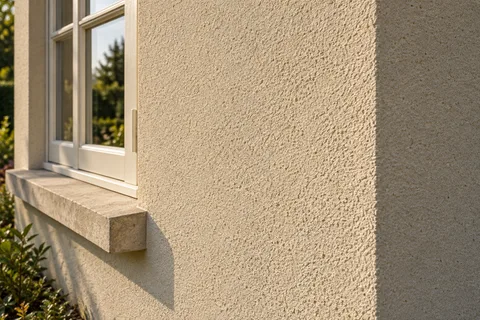
Render colour changes
Render respray in Middlesbrough
A respray changes the colour of render that is already on the wall. The render is cleaned, repaired where needed and then coated with a masonry paint or render coating, usually sprayed and back-rolled in two coats. It does not add strength or fix loose render, so it only suits walls where the render itself is sound.

On this page
When a respray is the right job
The best candidates are walls where the render is still well stuck but looks tired: a faded through-coloured monocouche, a sand-and-cement wall with a patchwork of repairs in different greys, pebbledash that has gone dark with dirt and algae, or a colour that no longer suits the house. Tap the wall first. If it rings solid and the cracks are fine, coating is realistic.
It is the wrong job when large areas sound hollow, when cracks are open enough to let rain in, or when render is crumbling near the ground. A coating over loose render comes away with it. Those walls need a render repair first, or a re-render. A respray also cannot change texture: a heavy pebbledash will still look like pebbledash in a new colour.
- Clean Washed down, with algae and mould treated and left to work.
- Repair first Cracks and hollow patches are repaired before any coating.
- Prime or stabilise Where the coating maker requires it on that surface.
- Coating Usually two coats of a breathable masonry or silicone coating.
The usual order of work. The survey and the chosen products decide the actual steps.
Choosing a coating that suits the render
Not every masonry paint suits every render. K Rend, for example, makes Colour Enhance specifically for existing rendered walls, old or new, and says it suits both scraped and unscraped finishes, so it can be used on a weathered monocouche. Its instructions are to treat algae first, complete repairs, and apply to a cured, dry, level surface free from efflorescence, with a first coat diluted 10–15% and a second coat undiluted once the first is dry. The same company lists a silicone masonry paint and a mineral paint, each applied in two coats and not below 5°C or above 30°C.
If the wall has been painted before, the new coating has to stick to that old paint. Scratch a hidden area: paint that flakes or lifts on tape needs scraping back or stripping, and chalky paint that leaves powder on your hand usually needs a stabilising primer first. Tell whoever is quoting what you know about the previous coating, even if it is only the year it was done.
Old walls rendered in lime are a special case. SPAB advises a limewash on lime render and warns that ordinary modern paints are less permeable and can trap moisture, so a plastic-based masonry paint is the wrong choice there.
What happens during a respray
Most of the time goes into preparation and masking rather than spraying.
Tap-test the walls and mark hollow areas, cracks and blown patches for repair.
Carry out repairs and give them time to cure before any coating.
Wash the walls down and treat algae or mould with a suitable cleaner, then let them dry.
Mask windows, doors, sills, roof edges, fittings and paving; cover nearby cars and plants.
Apply any primer or stabiliser the coating system requires on chalky or porous areas.
Spray the first coat and back-roll it into the texture, then let it dry.
Apply the second coat, remove masking and touch in edges by brush.
Spraying, overspray and the weather
Spraying gets coating into the hollows of pebbledash and textured render faster and more evenly than a roller alone, which is why it is common on rough finishes. Back-rolling works it into the surface. The risk is drift: fine paint mist carries on the wind onto glass, cars and next door's walls. On a terraced street or close to parked cars, masking and calm weather matter more than speed, and some edges are better brushed.
Coatings need a dry wall and dry weather to cure. Keep work off walls that are still wet from washing or rain, avoid frost, and follow the temperature range on the product: 5°C to 30°C for the K Rend coatings named above. A coat that is rained on before it has dried can streak or wash off.
Colour rules at some addresses
Painting the outside of a house is usually permitted development, but not everywhere. Middlesbrough Council's Article 4 direction for Linthorpe covers specified properties and includes controls over exterior painting, so check the council's address list before booking a colour change there. Outside the town, Redcar and Cleveland Borough Council's 2021 Article 4 direction for Saltburn Conservation Area removes permitted development for exterior painting on every building in the area.
Afterwards, keep the coating name and colour reference. Wash the walls gently when they get dirty, repair any chip or crack promptly, and recoat when the colour fades rather than waiting for it to fail.
Common questions
Can new colour hide old repair patches?
It evens out the colour, which hides most patches from a distance. Differences in texture or surface level can still show, especially in low sun.
Do I need to repaint the whole elevation?
For an even colour, yes: coating stops look obvious in the middle of a wall. Stop at corners, beads or downpipe lines.
See housing and planning information for Middlesbrough and nearby places, including the source and geography behind each figure.