Practical guide
Living in a bungalow while it is rendered
A bungalow is often rendered while someone is living in it, sometimes an older owner who spends most of the day at home. Because every room is next to an outside wall, every stage of the job is felt inside. Knowing what each stage involves, and how long each wall is likely to be covered, makes it much easier to plan the household round the work.

On this page
The stages, and what they feel like inside
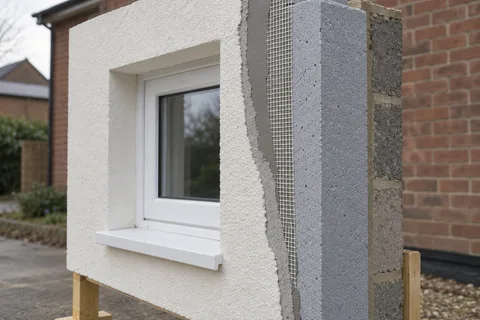
Most rendering jobs run in the same order. First comes setting up: scaffold or towers round the walls, sheeting over windows and doors, and clearing a working strip around the house. Then removal, if the old render or pebbledash is coming off, which is the loud, dusty part. Then repairs to the brick or block, beads, and the new coats with drying time between them. Finally, fittings go back and the scaffold comes down.
Removal is the hardest stage to live with. Hacking off render with hammer and bolster or a breaker is noisy and sends vibration through the walls. If the job includes stripping pebbledash, expect heavy debris and dust for a few days per elevation. Applying new render is quieter, but windows may stay sheeted for longer than expected while coats cure.
On a job that covers several walls, the work usually moves around the house one elevation at a time. That means the rooms most affected change from week to week.
Pebbledash removal adds a stripping stage that a colour-only job does not have. For house rendering around several elevations, the noisy and dusty part moves round the bungalow with the working area.

Windows, ventilation and light
While render is being sprayed or applied near them, windows and doors are covered in polythene. K Rend's data sheet for its K Mono monocouche, for example, tells installers to use polythene sheeting to protect doors, windows and other features from overspray. Covered windows mean darker rooms and no opening them, so think about where you will sit and sleep during the days your main rooms are affected.
Ventilation needs thought. Air bricks and trickle vents may be taped over temporarily to keep dust and render out, and they must be reopened afterwards. Boiler and gas fire flues must never be covered; if a flue terminal is on the wall being rendered, point it out before work starts.
Paths, doors and the garden
A low building still needs safe access to its walls, and the working area takes up space. Plant pots, benches, bins and washing lines along the walls need moving, and paths beside the house may be closed for days at a time. Agree which door stays usable at each stage, and where the bins and deliveries go meanwhile.
Planting directly against the wall will be trampled and splashed with render. Lift anything you want to keep, or accept that it may need replacing. Paving and drains are usually sheeted, but fine dust gets everywhere during removal.
Think about the people who visit. Carers, district nurses, family and delivery drivers may arrive at a door that is suddenly behind scaffold. A note on the gate saying which door to use, and a word with regular visitors, saves confusion. Pets need the same thought: a dog let into the garden during hacking off will be in the way of falling debris, and a cat flap in a sheeted door may be blocked for days.
Ask where materials will be stored and where the skip or waste bags will stand. Bags of render, sand and a mixer take up more room than people expect, and they should not block the only route to the door.
Things fixed to the walls
Before work starts, walk round the outside and list everything fixed to the walls: outside lights, taps, hose reels, cable clips, satellite dishes, alarm boxes, hanging-basket brackets and house numbers. Some can be unscrewed and stored by the household. Electrical items should be disconnected by an electrician, and gas or boiler flues dealt with by the appropriate engineer. Take a photograph of each item in place so it goes back where it was.
If the bungalow is getting external insulation rather than a plain re-render, almost everything on the walls has to come off and go back further out, on fixings designed for insulated walls.
Weather pauses
Render work stops for frost, rain and strong sun. K Mono's data sheet rules out application below 5°C or above 30°C or if frost is forecast within 24 hours; lime and silicone products have their own limits. A cold or wet week can leave the scaffold standing and the windows sheeted with nobody on site. That is normal, not a sign the job has been abandoned, but ask for an update whenever work pauses so you know when the sheeting can come off. If a covered window is the only one in a bedroom, ask for its sheeting to be lifted whenever no work is being done on that wall.
A worked example
Consider a hypothetical detached bungalow with pebbledash on four elevations and a lean-to at the back. The renderer might start on the gable with the fewest windows, strip it over two or three days, repair the brick, and apply the scratch coat, then move to the rear while the first coat dries. The front, with the living room and the main door, might be done last so that the household keeps its best room and entrance for as long as possible. The order is an illustration of how work can be arranged round a household, not a fixed plan.
In that example, the most disruptive week for each room is the removal week for its wall. The household could plan visits, appointments or a stay elsewhere round those weeks.
When the scaffold comes down
Walk round with the renderer before the scaffold is removed. Look at the sills, the bottom of the wall where the render should stop above the damp-proof course, the corners and the edges round windows and doors. Check that air bricks and vents are open again, and that every fitting on your list is back.
Keep the product names, colour references and care instructions together. If a crack or stain appears later, a photograph and those details give whoever looks at it a clear starting point. For other kinds of rendering work, see the Middlesbrough rendering homepage.
See housing and planning information for Middlesbrough and nearby places, including the source and geography behind each figure.